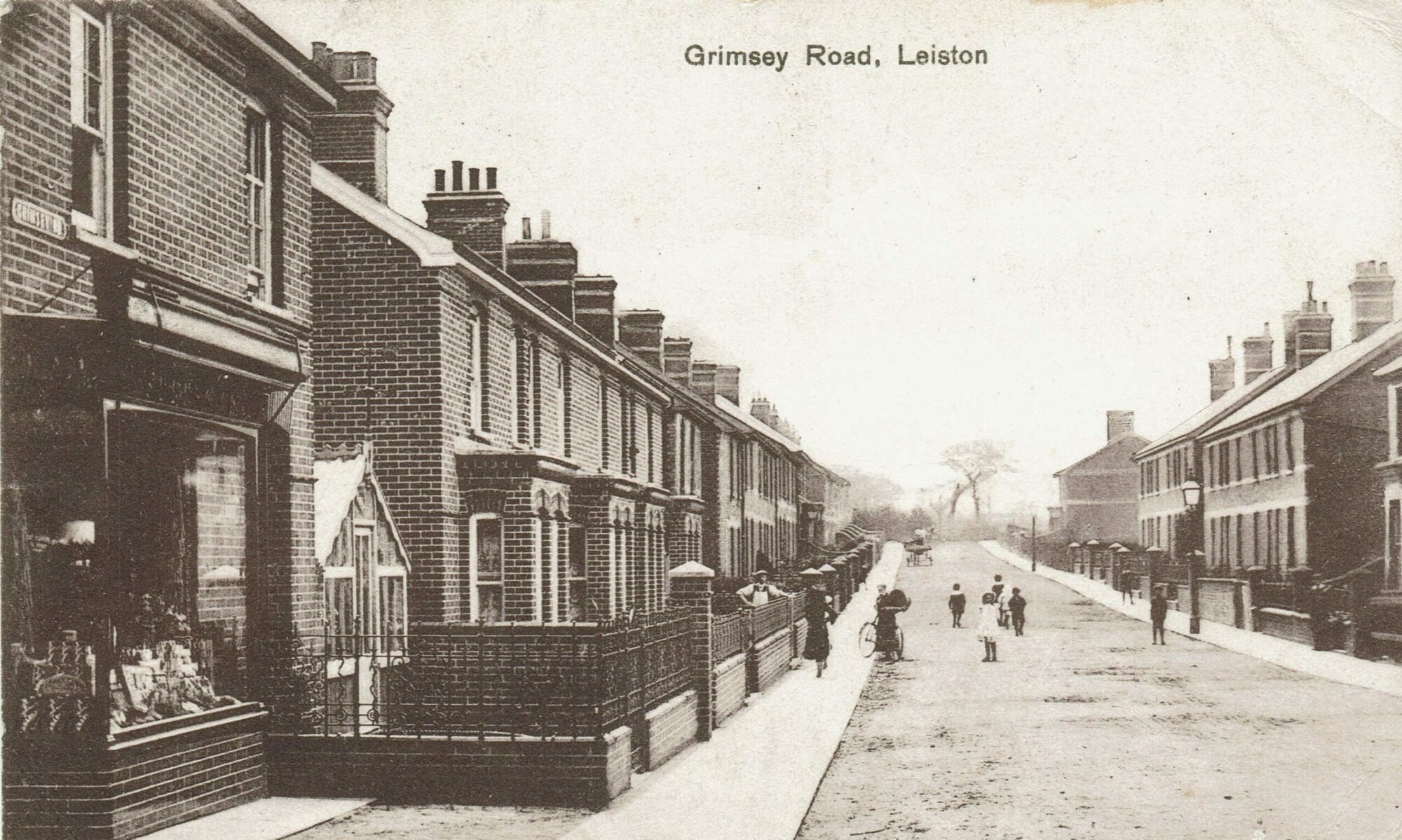
Set amid the Golden Gorselands
Yet in sound of lathe and drill.
Nature free and nature fettered
By man’s cunning, strength, and skill.
Stand these walls, this place of contrasts,
Where there flourish side by side,
Wisdom , knowledge, truth and learning,
Industry and vision wide.
(HEH Goldfinch)
From Wikipedia, the free encyclopedia
Leiston (/ˈleɪstən/ LAY-stən) is a town and civil parish in the East Suffolk district of Suffolk, England. It is close to Saxmundham and Aldeburgh, 21 miles (34 km) north-east of Ipswich and 90 miles (145 km) north-east of London. The town had a population of 5,508 at the 2011 Census.
From:-
HISTORY,
GAZETTEER, AND DIRECTORY
OF
SUFFOLK;
BY WILLIAM WHITE, 1855
LEISTON is a large and well built village, 2 miles from the sea, 4 miles N. by W. of Aldborough, and E. by S. of Saxmundham, 5½ miles S.S.E. of Yoxford, and 93 miles N.E. of London. Its parish comprises 4966 acres of land, and encreased its population from 1177 in 1841, to 1580 in 1851, and to about 1700 souls in 1854, owing to the great extension of the large machine works here. The parish includes the hamlet of SIZEWELL, which has 66 inhabitants, and 1000 acres, on the sea coast, 4 miles N. of Aldborougb, and had a chapel as late as the reign of Elizabeth, though no traces of it now remain.
At Sizewell Gap, there is a fishing boat and coast guard station, and the cliffs rise precipitously from the beach. The parish extends three miles N. of the church, and includes part of the Minsmere Level, as noticed with Theberton. Leiston Iron Works, established in 1778, by the grandfather of the present proprietors. Rd. Garrett and Son, is one of the largest manufactories of agricultural implements in the kingdom, and they are now patentees of various improved machines. They give employment to about 600 persons in the manufacture of all kinds of agricultural implements: thrashing and reaping machines, drills, horse-hoes, steam engines, &c., &c.
Messrs. Garrett and Son manufacture more agricultural implements than any other firm in the world, and they have carried off a large portion of the prizes awarded during the last twenty years at agricul tural and other exhibitions in various parts of the kingdom. Their works have lately been much enlarged, and now extend over about eight acres of ground. Their machinery is driven by three powerful steam engines, and their gas works also light many of the houses &c., in the village. In 1840 they contracted for the better drainage of the Minsmere Level, and they have succeeded in stopping those frequent inundations which had previously rendered this tract of about 1500 acres of low marshy land, almost valueless. (See Theberton.)
An ABBEY of Premonstratension canons, dedicated to the Blessed Virgin, was founded in the parish about the year 1182. by Ranulph de Glanville. who endowed it with the manor of Leiston, conferred upon him by Henry II., and also certain churches, which he had previously given to Butley Priory, and which that convent resigned in favour of this abbey, which stood originally in a marshy situation, near the sea and the Minsmere river, where there are still some small ruins called Leiston Chapel, near Minsmere Haven, more than 2 miles N.N.E. of the village of Leiston.
The situation of the first house being unwholesome, Robert de Ufford, Earl of Suffolk, about the year 1363, built a new abbey on a larger scale, upon an eminence about a mile N. of Leiston church, to which the monks removed. This edifice was destroyed by fire before 1389 but being rebuilt, it continued to flourish till the general dissolution, when it contained 15 monks, and its annual revenues were valued at £181. 17s. 1½d. Great part of the church, several subterraneous chapels, and various offices of the monastry. are still standing, and. applied to the purposes of barns, granaries, &c. The length of the abbev church was about 56 yards, and it appears to have been a handsome structure, decorated with ornaments, formed by an admixture of black squared flints and freestone.
In the walls of the church, and other buildings, are many bricks, thinner and longer than those used at present. Near the west end is a small tower entirely of brick, but having various ornaments which have been formed in moulds. The outer walls of this abbey enclosed a great extent of ground, but they have been removed for the sake of the materials.
The old abbey, near tbe sea, appears to have been used by some of the monks till the dissolution; and in 1331, “John Grene, relinquishing his abbaice by choice, was consecrated an anchorite at the chapel of St. Mary, in the old monastery near the sea.” In the 28th of Henry VIII, the site of the abbey, and the manor of Leiston, were granted to Charles Brandon, Duke of Suffolk, and afterwards passed to the Herveys. They now belong to Lord Huntingfield, who has a neat house here, called the Cupola, which he occasionally visits. The other principal landowners in the parish are the late J. P. Thellusson, Esqrs.’s Trustees ; Edw. Fuller, Esq., Capt. Rowley, and Mr. J. Grimsey.
The abbot obtained a charter for a market and fair at Leiston, in 1312, but both have long been disused. The Abbey House is the seat of the Dowager Lady Rendlesham, relict of the second Lord Rendlesham, and daughter of are late W. Tatnall, Esq., who was seated here.
The parish Church (St. Margaret,) was rebuilt, except the tower, in 1854, at the cost of about £2500, mostly contributed by Miss Thellusson, Lady Rendlesham, the Incumbent, and the parishioners. It has a spacious nave, transept, and chancel, built of Kentish rag stone and flint, with Caen stone dressings, in the decorated style of the time of Edward III. The old Church was a long thatched fabric of great antiquity.
The living is a perpetual curacy, valued at £376, in the alternate patronage of Christ’s Hospital and the Haberdashers Company, London, and the incumbency of the Rev. J. C. Blaithwayt, M.A. The benefice has been endowed by the patrons with all the tithes, which were commuted in 1810 for £435 per ann. Here is a Wesleyan Chapel, built in 1848, and an old Friend’s Meeting House.
The National School was built in 1837, at the cost of £350, and has room for 170 boys and girls. Here is also an Infant School, supported chiefly by Lady Rendlesham. Here is also a well-conducted Mechanics’ Institution and Mutual Improvement Society, established in 1850, and having a news room, a library of 1100 volumes, and a numerous list of members. During the winter months it has frequent evening lectures. Richard Garrett, Esq., is the president, and Mr. Wm Heard, secretary.
In 1721, Thomas Grimsey left a farm of 38A., at Westleton, to provide clothing for poor widows and children of Leiston, and it is now let for £46 a year. The same donor left £200, to be invested by the churchwardens, for a distribution of bread among the poor, every Sunday, at the church. Of this legacy £150 was placed out on mortgage, and the residue was laid out in the purchase of a cottage on Coldfair green, which lies south of Leiston, and is mostly in Knodishall parish. This cottage lets for £6, and another cottage derived from the mortgage is let for £7 a year.

